Friday, September 21, 2012

Eritrea: Freedom of Religion

Abraham G. Ghiorgis
New York

The article “Freedom of Religion” pasted below is a compilation of two pieces – essential principles of freedom of religion and history of freedom of religion – taken from the Democracy Web.

This may help Eritreans to understand from historical and conceptual viewpoints what the “freedom of religion" means, and its role in dismantling a dictatorship. On this very subject some writers at Awate.com are off track and are throwing ideas at us without diligently doing their homework. I hope this post may counterbalance their themes at least from a theoretical viewpoint.

Freedom of religion is one of the pillars of liberal democracy. The concepts of liberal democracy, the rule of law and civil liberties are fundamentally developed by western civilization. These public goods in highly refined forms are products of the "Enlightenment, a general term applied to scientific and philosophical developments in Europe in the seventeenth and eighteenth centuries." Like all universal truths these principles of liberty benefit all human societies. And we, Eritreans, like all others in the developing world who want to establish liberal democracies should accept them and struggle hard to internalize them for the benefit of our own good. In this respect we need a deep understanding of the concepts. For this purpose, there is no better and tested mandatory book to read than “The Constitution of Liberty” by F. A. Hayek. This was a required book to read for the old nations of the Soviet Union in their transition to liberal democracy and the rule of law. This is ongoing. It never stops. It is almost a bible and a guide book for the Economist magazine.

As documented by many human rights organizations, the PFDJ regime in Eritrea violates the religious beliefs of all Eritreans. No one is spared -- the Tewahdos, the Muslims, the Catholics, all Protestant denominations and all others.

The Patriarch of the Tewahdo Church was illegally removed from his post and put under house arrest by the PFDJ regime. The primary reason is in order to emasculate the Tewahdo Church –- an African institution of a long standing which is a depository of the traditions and cultures of a big portion of the Eritrean people. And the Tewahdo Church can be a strong bulwark against the tyranny of the PFDJ regime. Only someone with a religious agenda in Eritrea will claim that the Christian Highlanders are benefiting from the current political order in Eritrea. By now we are accustomed with some of these writers at Awate.com.

Some of these folks now are creating out of thin air religious bickering among the Eritrean people. There is a lot of religious fight and fanaticism in the Middle East, Afghanistan, Pakistan, India, Indonesia, Mali, and Nigeria. At least on this devilish issue that is consuming a major part of the world, so far either out of pure luck or that the Eritrean people are a very tolerant people, we are left unaffected. Count our blessings. And thus, we should not allow anyone how erudite one maybe to lump the Eritrean people with the religious fanaticism that is going in the above listed nations. As it is we have enough problems of our own, but those have to do with the autocracy of the PFDJ regime and not with the imagined "religious intolerance" that some are ascribing to the Eritrean people.

As aside no one has a right to impose on the Eritrean people who they should consider as their heroes and fathers of the Eritrean nation. This has to do with the freedom of expression. It is a topic for another day. (Till then please see:http://www.democracyweb.org/expression/principles.php )

For now, to answer that question let us go to American history. Many in America consider Washington, Adams, Jefferson, Madison, Hamilton, and Franklin as the fathers and heroes of the American nation.

Some and that include many African Americans do not consider Washington, Jefferson, and Madison as heroes and fathers of the USA. To speak for myself, I admire these people for their accomplishments but they are not my heroes either. Why? They were hypocrites. They fought for liberty and yet denied liberty for black Americans. While, Adams, Hamilton and Franklin were for liberty for all including freedom for black Americans; at least on this fundamental issue, which later caused a devastating civil war in America, their stand on liberty was consistent and they were not hypocrites. In my book, when it comes to politics, no one is equal to Alexander Hamilton -- a true hero and father of the American nation. (See (1) "Founding Brothers" by Joseph J. Ellis and (2) “Alexander Hamilton” by Ron Chernow.)

The beauty of the USA -- a liberal democratic nation -- is that no one will declare a fatwa on those of us who do not take Washington and his pals from Virginia – slaveholders – as heroes and fathers of the USA.

Yet, the Awate Team has arrogantly elevated itself to the position and power of an autocrat in the internet and is foolishly ostracizing Eritreans who do not consider certain personalities as their heroes and fathers of the Eritrean nation. For the record, I do not consider anyone who is or was in the leadership of the ELF and the EPLF as my hero or father of Eritrea. Why? There is nothing to show for it.

When it comes to Eritrea, my only heroes are the Eritrean people, Eritrean citizens who gave their blood and their lives for as of yet unrealized liberal democratic Eritrean state – these honorable personages include my own biological brothers and cousins and my lifelong friends.

I am more than glad to be ostracized by a poor man's autocrat.

Abraham G. Ghiorgis
New York

(Revised for minor grammatical errors on September 24, 2012.)

Note: the blogspot noted below has a reading list of books on the subjects of property rights, rule of law, and constitutional government. Also included are previous articles published in Eritrean websites and other relevant articles on Eritrea and Ethiopia. The site is as follows: http://eritreamereb.blogspot.com/


---------------------------------------------------------------------------------------------------------------------------

Freedom of Religion
by the Democracy Web


(I) ESSENTIAL PRINCIPLES OF FREEDOM OF RELIGION


"Everyone has the right to freedom of thought, conscience and religion; this right includes freedom to change his religion or belief, and freedom, either alone or in community with others and in public or private, to manifest his religion or belief in teaching, practice, worship, and observance."

UN General Assembly, Universal Declaration of Human Rights, Article 18, 1948

For most of world history, emperors and kings based their legitimacy on claims of divinity or divine approval. Differences in religious beliefs between rulers and within states were the cause of wars, revolts, and persecution. While few world leaders explicitly claim divine legitimacy today, religion remains a central factor in many of the world's conflicts, including the Balkan wars of the 1990s, Russia's war in Chechnya, and the Islamist terrorism of al-Qaeda. Countless innocent lives have been lost because of a fundamental lack of respect for freedom of religion and an intolerance of people with different beliefs.

The long history of brutal religious wars in Western Europe helped give rise to the modern notion of religion as a matter of individual conscience, rather than an official policy of the state. This concept of freedom of belief became one of the core ideas of American and European democracy, or what is sometimes called the "first freedom" because of its place in the U.S. Constitution's Bill of Rights. Without the ability to think, believe, and worship freely, and without the principle of toleration of others' beliefs, there can be no democracy. Citizens are unable to exercise their free choice in either religion or politics, leading to the frustrations that help fuel violent conflict.

The transformation of religion from a justification for war or for a state's existence into an object of political liberty and individual conscience is one of the most important stories of modern history—and a story that is still unfolding. It has been at the heart of the development of liberal democracy, and where it remains incomplete, political life is often defined by dictatorship or terrorism.


(II) HISTORY OF FREEDOM OF RELIGION


A Brief Survey of Major Religions


Until recently, the state and religion were closely intertwined, with one buttressing the other in both internal governance and expansion abroad. The ancient Egyptians, Greeks, Persians, and Romans, among others, invoked divine support for their wars and empires, and saw religious devotion as a key component of loyalty to the state. Rulers including the pharaohs of Egypt, the emperors of Rome, and Alexander the Great considered themselves divine. Even democratic Athens could not tolerate dissent from its official polytheistic beliefs, sentencing the philosopher Socrates to death on charges of impiety and corrupting the young with his unorthodox teachings.


The major religions that survive today have also been central elements of different empires and autocratic systems. Hinduism, a polytheistic religion that emerged in the second millennium BC, fostered dynasties and kingdoms throughout South and Southeast Asia. Buddhism, founded in northern India in the sixth century BC, was similarly adopted by various expansionist monarchies in the region. Chinese emperors oversaw a complex of religions and practices (Confucianism, Taoism, Buddhism, and traditional beliefs). Although religion was suppressed at the outset of Communist rule in 1949, most people in China today maintain some elements of these former state religions. Hinduism, Chinese traditional religion, and Buddhism now constitute the world's third, fourth, and fifth largest faiths, with an estimated 900 million, 400 million, and 375 million followers, respectively.


Christianity and Islam, both monotheistic religions, are the two largest faiths, with two billion and 1.3 billion adherents, respectively. Each expanded significantly through conquest or adoption as an official state religion, and each experienced major schisms that resulted in bloody internecine wars. Christian and Muslim states also engaged each other in centuries of intermittent combat in Europe, the Mediterranean, and elsewhere.

Judaism, a small religion of 13 to 14 million adherents, is considered the world's oldest monotheistic faith, originating more than 3,000 years ago. It served as the foundation of both Christianity and Islam. Jews initially formed a state centered on Jerusalem, and the city remained at the center of their religious and political life until AD 70, when the Romans destroyed the Jewish Temple in the wake of a rebellion. For the next two millennia, Jews scattered in a worldwide diaspora, periodically experiencing persecution by governments and populations of other faiths. Nazi Germany's monstrous Holocaust killed six million Jews, or two-thirds of European Jewry. In 1947, the international community approved a plan to create a Jewish state in Palestine, and the state of Israel was established the next year, mostly on lands settled by Jews from the diaspora during the late 19th and early 20th centuries. Today, roughly six million Jews—and one million mostly Muslim Arabs—live in Israel (see Country Study of Israel).

In the cases above, the state never lacked an official religion, though religions frequently persisted without a state. The official religion served as a key element of the state's legitimacy and practices. The ruler was regarded as a spiritual leader, as the worldly representative of the divine, or at least as an administrator governing with the tacit approval of divine powers. Those who adhered to other faiths, especially faiths that could not accept or accommodate the legitimacy of the established system, were generally persecuted or restricted in their practices. It is only in recent centuries that states began to allow a freedom of religion in which no specific beliefs or observances were required of the population. Below is a discussion of how this understanding of state and religion developed.

The Reformation and Religious Wars
In Europe, the basic principle joining state to religion was expressed in the Latin phrase cuius regio, eius religio, literally "whose region, his religion." In other words, the religion of the ruler would be the faith of his subjects. This principle meant, for example, that the Roman emperor Constantine's conversion to Christianity in the fourth century led to its eventual recognition as the official religion of the empire.

The emperor remained the head of Christianity in the Eastern Roman (or Byzantine) Empire, based in Constantinople; the Byzantine Church served as the forerunner of today's various Eastern Orthodox Churches, which, like the original, generally conform to political borders and are at least loosely tied to the state. Meanwhile, following the fall of Rome to barbarian invasions in the fifth century, the papacy emerged as a supranational entity that exercised authority over all of the defunct Western Roman Empire and the lands to the north. Kings and emperors repeatedly clashed with popes over the extent of this authority, but all rulers who accepted Christianity (Roman Catholicism) had to recognize the pope's religious supremacy. The Church reserved the power to excommunicate disobedient princes, sanction crusades, and combat heresy through institutions like the Inquisition.

On October 31, 1517, German theologian Martin Luther posted his famous Ninety-five Theses in the University of Wittenberg, attacking the Church's practice of selling indulgences, or the remission of punishment for sins, which he argued had led to the Church's corruption. The event has come to symbolize the beginning of the Reformation—the temporal and spiritual challenge to the Catholic Church's doctrines, practices, and authority. Earlier dissidents such as Jan Hus of Bohemia and John Wycliffe of England had advocated reform and criticized corruption within the Church, but Luther and other theologians, who came to be known as Protestants, were the first to attack basic Catholic dogma and undermine the institution of the papacy. Luther, John Calvin, and other Protestant thinkers hardly believed in freedom of religion. They advocated what they considered to be a purer form of Christianity, and their teachings became the official religions of city-states, principalities, and kingdoms in Central and Northern Europe. In 1534, King Henry VIII of England nullified the pope's authority and declared himself to be the head of a separate, national Church of England.

The proliferation of new sects, both official and dissident, led to further repression and conflict. Catholic minorities in Protestant states were seen as agents of foreign Catholic rulers, who in turn viewed their Protestant minorities as disloyal heretics. Protestant governments also faced challenges from more radical sects and movements. Catholic and Protestant states, vying for both temporal and spiritual supremacy in Europe, began a series of bloody religious wars that lasted about a century and caused millions of deaths. (In the German principalities, as much as a third of the population may have perished in the Thirty Years' War alone, from 1618 to 1648.)

The religious wars resulted in a number of important treaties—the Union of Utrecht (1579), which marked the emergence of a Protestant, united, and effectively independent Netherlands; the Edict of Nantes (1598), which granted civil and religious rights to Protestants in France; and, finally, the Treaty of Westphalia (1648), which ended the Thirty Years' War and included important provisions for religious toleration between and within states.

The Rise of Liberal Democracy and Freedom of Religion

The emergence of religious freedom as an individual right was clearly tied to exhaustion after the religious wars in Europe. But it was also a product of the Enlightenment, a general term applied to scientific and philosophical developments in Europe in the 17th and 18th centuries. Years of conflict had resulted in a partial acceptance of religious diversity, and with it diversity of thought, leading European scholars to place a new emphasis on human reason as the basis of knowledge. Just as theologians of the Reformation had challenged authority and tradition to seek out their true relationship with God, Enlightenment thinkers questioned the established wisdom of their time and attempted to uncover the fundamental laws of nature. The Enlightenment's scientific focus sparked the rise of Deism, a form of monotheistic belief that rejected supernatural revelation and divine intervention in the world, instead imagining God as the rational architect of the universe. Deism was espoused by many of the founders of the United States, including Thomas Jefferson, who viewed the varying forms of religion and worship as a matter of personal opinion and saw any state involvement as coercive or corrupting. When it came to religious belief, he argued, each man was accountable only to "his God."

This was more than a theoretical matter for Jefferson. Witnessing the repression of Quakers and other minorities in states that had adopted restrictive laws on religion, especially his own Virginia, he noted that the contradiction between the political liberties of the new country and its ongoing religious intolerance posed a threat to its survival. In 1786, the Virginia Legislature passed his Statute for Religious Freedom. It declared in part that no man shall be compelled to frequent or support any religious worship, place, or ministry whatsoever, nor shall be enforced, restrained, molested, or burthened in his body or goods, nor shall otherwise suffer on account of his religious opinions or belief; but that all men shall be free to profess, and by argument to maintain, their opinions in matters of religion, and that the same shall in no wise diminish, enlarge, or affect their civil capacities.

The Constitution's First Amendment built these ideas into the nation's legal foundation: "Congress shall make no law respecting an establishment of religion, or prohibiting the free exercise thereof." For the first time in history, a formal separation of church and state guaranteed everyone the right to worship as his or her conscience dictated.

Today, many find it hard to believe that religion and religious institutions once played a dominant role in state affairs, and that entire societies could be forced to adopt a single faith to the exclusion of any other. Tolerance for a variety of religious beliefs, freedom of conscience, and separation of church and state, whether by constitutional provision or in practice, were revolutionary ideas that are now established in constitutional law in much of the world. The widespread acceptance of these ideas advanced not just religious liberty but also the broader values of democracy.

Freedom of Religion, Dictatorship, and Antidemocratic Ideology

As noted above, religious persecution has had a long history. And where freedom of religion has not been respected, government has typically been in the hands of some form of autocrat whose rule is bolstered by the obligatory state religion.

In the 20th century and especially during its decades of rising totalitarianism, the use of religion for political purposes took new forms. The Fascist dictator Benito Mussolini of Italy was antireligious, but in order to consolidate his power he obtained a formal agreement from the Roman Catholic Church in 1929, giving a sense of moral legitimacy to his government in return for concessions to the Vatican, including making Catholicism the state's official religion. The Nazis, on the other hand, emphasized what they considered a higher belief system—a strict racist ideology—and Christian denominations were forced to choose between subservience and persecution. Many churches, whether out of sympathy for or fear of this ideology, did little to resist Nazi tyranny and often assisted in implementing its worst policies. Nazi Germany and, under growing Nazi influence, Fascist Italy subjected their minority Jewish populations to persecution, imprisonment, deportation, and mass murder.

Communism initially made no attempt to co-opt religion, which Karl Marx had characterized as "the opium of the people." Instead, it attempted to abolish religious beliefs and replace them with its own materialist ideology. Following the Russian Revolution in 1917, the Bolsheviks destroyed churches, arrested and killed many priests, and banned observance of all faiths. Communist China similarly destroyed places of worship and religious relics and symbols. But when it suited their purposes, Communist regimes also reinstituted religion. After Nazi German forces invaded and threatened to overrun the Soviet Union, Soviet leader Joseph Stalin looked to the Russian Orthodox Church to rally support for what is known in Russia as the Great Patriotic War. He reopened churches and restored the Russian patriarchate, or church leadership, on the condition that it accept the Communist regime's authority. Thereafter, religious institutions were allowed to function in the Soviet bloc, but frequently as state instruments and always under strict supervision. Religious officials, including Islamic clerics, were handpicked by the state and often served as police agents or informers. Independent churches in Communist countries were outlawed and repressed. There were exceptions, however, including the Roman Catholic Church in Poland. It continued to answer to the pope in Rome and later became a driving force in the anti-Communist movement of the 1980s, although some clerics were subsequently found to have collaborated with the authorities.

There remain many current cases of religious repression around the world: China's brutal crackdown on the Falun Gong, a spiritual movement based on meditation; Vietnam's campaign against minority Protestants; and Islamist militant attacks on rival or non-Muslim sects in Iraq, among others (see Center for Religious Freedom at http://crf.hudson.org).

In recent years, extreme variants of Islamism— a political ideology that calls for government according to the principles of Islam—have arisen as a new antidemocratic phenomenon. Moderate Islamist groups have organized as political parties and worked within existing electoral systems, but the extremist factions have recruited and mobilized small cadres of terrorists to attack both governments and civilian populations in pursuit of their goals. This small minority has often provoked fresh political and religious repression by authoritarian regimes, and new security measures by democratic states attempting to cope with the threat. While terrorist acts are almost universally condemned, Islamist extremists have won varying degrees of sympathy among Muslim populations, potentially eroding Islam's centuries-old tradition of tolerance.

Extreme Islamist ideology emerged partly in response to the failures of the secular, pan-Arab nationalist movement, which had been unable to dislodge the new state of Israel, unite the Arab people, end dependence on foreign powers, or deliver basic public goods like the rule of law, civil liberties, and, in many cases, economic prosperity. Unlike nationalists, Islamist extremists see themselves as fighting for Muslims worldwide, giving them a similarly expansive list of perceived foes. They also bolster their violent tactics with religious claims, such as the notion that God will reward those who carry out suicide attacks, even on civilians who are deemed enemies.

Some observers have compared Islamist extremism with fascism (a term that includes the original Italian fascism and German Nazism, among other examples), in that it violently promotes the supremacy and purity of one group—a religious community in this case, rather than a race or a nation—and regards any other group, institution, or principle as utterly expendable in the quest to restore this group's past or rightful glory.

Conclusion

The examples of antidemocratic ideology and dictatorship discussed above illustrate the need for freedom of religion and the basic separation—either formally or in practice—of religion and state. Without such a separation, religious institutions have historically become either repressive political instruments or compromised entities that are unable to fulfill their proper functions. Dictators view freedom of belief as a threat because it can undermine individual obedience and mobilize community opposition. Independent religious institutions have been part of many recent movements for broader political freedom, including those in Chile, Poland, and South Africa.

Just as freedom of religion is a menace to dictatorship, it is a safeguard of democratic society. Democracy requires a diversity of views and choices, an environment in which differing opinions can be debated freely. This would be impossible if there were intolerance of "the first freedom"—freedom of conscience and of worship.

Source: http://www.democracyweb.org/religion/principles.php

Tuesday, September 18, 2012

Libya, Violence and Free Speech

Stanley Fish
The New York Times, September 17, 2012

Back when Salmon Rushdie was made the object of a fatwa because his book “The Satanic Verses” was regarded by many Iranians as a blasphemy against the prophet, I went to a conference where a panel discussion was devoted to Rushdie’s situation. A member of the audience raised his hand and, without a trace of irony, asked, “What’s the matter with those Iranians? Haven’t they ever heard of the First Amendment?”

The implication was that if they had heard of it and read it and gotten its message, they would have understood that you don’t target or attack people because of what they have written; you don’t respond to words, however harsh and wounding you take them to be, as if they were physical blows. Now, in the wake of the events in Libya, the same kind of thing is being said by American politicians and commentators. If you’re listening to the radio and tuning in to the cable news shows, you’re hearing any number of people (including Secretary of State Hillary Rodham Clinton) declare, first, that of course the video vilifying Islam is reprehensible and, second, that nevertheless nothing can justify the eruption of “senseless violence.”

“Senseless” means without reasons, and the assumption is that it can’t be a reason to set a consulate on fire that someone in the consulate’s home country made a movie saying nasty things about your religion. After all, if your religion is worthy and strong it will survive a malicious representation of it. And besides, an assault on your religion is not an assault on you; it’s not personal. This is the point made by the Florida pastor Terry Jones, who insists that the video (with which he is associated in some way not yet specified) was “not designed to attack Muslims, but to show the destructive ideology of Islam.” In other words, we’re not attacking you, just some of the ideas you hold, an assertion that makes sense if you think that your religion is just an add-on to your essential personhood, like the political party you belong to or the football team you root for.

That is the view of religion we inherited from John Locke and other “accommodationist” Protestants, Protestants who entered into a bargain with the state: allow us freedom of worship, don’t meddle in our affairs and we won’t meddle in civic matters or attempt to make public institutions reflect theological doctrines. In his Letter Concerning Toleration, Locke is eloquent when he explains how this parceling out of the world into two distinct spheres — a private sphere and a public sphere — will put an end to the violence that is likely to occur when religious imperatives stray from their proper home in the heart and the chapel (or mosque or synagogue) and insist on ordering every aspect of life. If church and state will “each of them contain itself within its own bounds, the one attending to the worldly welfare of the commonwealth, the other to the salvation of souls, it is impossible that any discord should have happened between them.”

Those who buy into this division of labor and authority will themselves be bifurcated entities. In their private lives they will live out the commands of their religion to the fullest. In their public lives — their lives as citizens — they will relax their religious convictions and display a tolerance they may not feel in their heart of hearts. We give witness to this dual identity when we declare, in fidelity to the First Amendment, “I hate and reject what you say, but I will defend to the death your right to say it.”

It hardly needs pointing out that the protesters in Libya and Egypt won’t say that — not, however, because they don’t understand the First Amendment or the firewall that should separate religion from civil life or the distinction between one’s identity as a citizen and one’s identity as a believer or the difference between words and blows, but because they reject all four and, indeed, regard them as evil. In their eyes, a religion that confines itself to the heart and chapel, and is thus exercised intermittently while the day’s business gets done, is no religion at all. True religion does not relax its hold when you leave the house of worship; it commands your allegiance at all times and in all places. And the “you” whose allegiance it commands is not divided into a public “you” and a private “you”; it is the same at home as it is when abroad in the world.

And since for them religion is not an internal, privatized matter safe from the world’s surfaces, but an overriding imperative that the world’s surfaces should reflect, a verbal or pictorial assault on their religion will not be received as an external and ephemeral annoyance, as a “mere” representation; it will be received as a wounding to the heart, as a blow, and as a blow that is properly met by blows in return. No “sticks and stones will break my bones but names will never hurt me” for them.

So the entire package of American liberalism — the distinction between speech and action, the resolve to protect speech however distasteful it may be, the insistence that religious believers soften their piety when they enter the public sphere — is one the protesters necessarily reject. When they are told that the United States government had no part in the production of the video and deplores its content, educated Libyans and Egyptians reply (reporters tell us), “Well, if they think it’s bad and against their values, why didn’t they stop it or punish those who produced it?” The standard response is that we Americans don’t suppress or penalize ideas we regard as wrong and even dangerous; in accordance with the First Amendment, we tolerate them and allow them to present themselves for possible purchase in the marketplace of ideas.

But that means that protecting the marketplace by refusing to set limits on what can enter it is the highest value we affirm, and we affirm it no matter what truths might be vilified and what falsehoods might get themselves accepted. We have decided that the potential unhappy consequences of a strong free speech regime must be tolerated because the principle is more important than preventing any harm it might permit. We should not be surprised, however, if others in the world — most others, in fact — disagree, not because they are blind and ignorant but because they worship God and truth rather than the First Amendment, which not only keeps God and truth at arm’s length but regards them with a deep suspicion.


Saturday, August 25, 2012

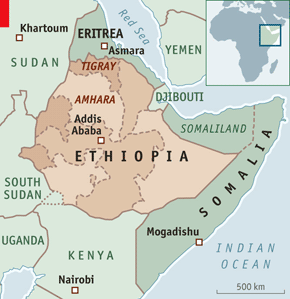
The Horn of Africa after Meles Zenawi

The Economist
August 25, 2012

Bye-bye big man. The lessons for Africa’s most troubled region from the career of its most able leader.


SOME countries have a habit of suffering in unison. As in the Balkans and the Caucasus, the ethnically diverse countries of the Horn of Africa often infect one another. Ethiopia, Sudan and Somalia have all spilled internal conflicts and misrule across borders. Two historic events this week may now open up a new chapter in the Horn’s history. Both could pave the way towards greater political openness and prosperity—but only if the West applies pressure in the right way.
 
The first event occurred in Somalia, which convened its first parliament in living memory (see article). Representatives from all regions and clans, often warring, met in the recently liberated capital, Mogadishu; they are now expected to choose a president in a competitive, if imperfect, vote. National elections are next on the agenda. There are plainly risks: many of Somalia’s politicians are crooks; and the Shabab, an extreme Islamist militia that controlled most of the country until recently, remains a threat. But Somalia probably has its best chance of finding an inclusive government since it descended into internecine fighting and frequent famine after the overthrow of Siad Barre in 1991.

All this was, however, overshadowed by the second event: the death of Ethiopia’s prime minister (see article). Meles Zenawi, who had been in power ever since his forces ousted the Marxist junta of Mengistu Haile Mariam in 1991, was the Horn’s dominant figure and the West’s main ally in the region. How Africa interprets his legacy will matter enormously.

There is much to praise. Mr Meles lifted millions out of abject poverty and devoted himself to finding workable development policies. During his two-decade rule, Ethiopia went from being a byword for starvation to a substantial food exporter. But Mr Meles also became increasingly dictatorial. Elections were rigged and prisons filled with political activists. The bargain he foisted on his people—food for autocracy—ultimately curbed their potential. Technology, an engine of freedom as well as growth elsewhere, is reserved for the elite. Ethiopian Airlines has just become the first non-Japanese owner of Boeing’s Dreamliner aircraft, but the rate of mobile-phone use is among the lowest in the world.

Beware the myth

Many African dictators saw in Mr Meles another feature bolstering their own positions: a proof of the need for top-down government. Look, they said, 10% GDP growth and no real elections! Western leaders embraced him too—with one arm, holding their noses with the other hand. He received $4 billion in aid a year, and mostly put it to good use.

But Ethiopia is no model. Mr Meles’s death exposes the dangers of building a state around one man, no matter how competent. He leaves a powerful machine that none but he could steer. The hope is that with no leader of his stature in the wings, power will inevitably be shared. The yes-men with whom the brainy but paranoid Mr Meles surrounded himself cannot exert control alone. The fear is that members of Ethiopia’s elite may fight for control, ethnic movements on the periphery could be emboldened by a power vacuum and Eritrea might sense an opportunity to destabilise its arch-foe.
 
Leaders in Rwanda and Angola, two other booming strongman states, should take note. Institutions matter. Western donors have lessons to learn as well. Competence in African leaders is no substitute for fairness. Involved as it is in the fiendishly difficult process of ensuring a peaceful succession in Ethiopia and choosing a president in Somalia, the West should resist the temptation to look for another Meles. Democracy is the Horn’s best hope.

Source: http://www.economist.com/node/21560880

Thursday, August 23, 2012

Ethiopia's prime minister, man who tried to make dictatorship acceptable


The Economist
August 25, 2012

What will follow one of Africa’s most successful strongmen?

THE death of Meles Zenawi, Ethiopia’s prime minister, on August 20th reveals much about the country he created. Details of his ill health remained a secret until the end. A short broadcast on state television, late by a day, informed Ethiopians that their “visionary leader” of the past 21 years was gone. He died of an unspecified “sudden infection” somewhere abroad. No further information was given. In the two months since the prime minister’s last public appearance the only Ethiopian newspaper that reported his illness was pulped, its office closed, and its editor arrested. Further details of Mr Meles’s death surfaced only when an EU official confirmed that he died in a Brussels hospital.

A towering figure on Africa’s political scene, he leaves much uncertainty in his wake. Ethiopia, where power has changed hands only three times since the second world war, always by force, now faces a tricky transition period. Mr Meles’s chosen successor is a placeholder at best. Most Ethiopians, whatever they thought of their prime minister, assumed he would be around to manage the succession. Instead he disappeared as unexpectedly as he had arrived. He was a young medical student in the 1970s when he joined the fight against the Derg, the Marxist junta that then ruled Ethiopia. He went into the bush as Legesse Zenawi and emerged as “Meles”—a nom de guerre he had taken in tribute to a murdered comrade.

Who exactly was he? As leader of the Tigrayan People’s Liberation Front, an ethnic militia from the country’s north, he presented himself to his countrymen as a severe, ruthless revolutionary; yet Westerners who spoke to him in his mountain hideouts found a clever, understated man who laid out, in precise English, plans to reform a feudal state. In 1991, after the fall of the last Derg leader, Mengistu Haile Mariam, the 36-year-old Mr Meles (pictured above) took power, becoming Africa’s youngest leader. He had moral authority as a survivor of various famines. Western governments and publics, who became aware of Ethiopian hunger through the Band Aid and Live Aid charity concerts, gave freely. Mr Meles was often able to dictate terms under which donors could operate in Ethiopia and turned his country into Africa’s biggest aid recipient.

Where others wasted development aid, Ethiopia put it to work. Over the past decade GDP has grown by 10.6% a year, according to the World Bank, double the average in the rest of sub-Saharan Africa. The share of Ethiopians living in extreme poverty—those on less than 60 cents a day—has fallen from 45% when Mr Meles took power to just under 30%. Lacking large-scale natural resources, the government has boosted manufacturing and agriculture. Exports have risen sharply. A string of hydroelectric dams now under construction is expected to give the economy a further boost in the coming years.

The flipside of the Meles record is authoritarianism. Before his departure he ensured that meaningful opposition was “already dead”, says Zerihun Tesfaye, a human-rights activist. The ruling party controls all but one of the seats in parliament, after claiming 99.6% of the vote in the 2010 elections. It abandoned a brief flirtation with more open politics after a vote five years previously, when the opposition did better than expected. The regime subsequently rewired the state from the village up, dismantling independent organisations from teachers’ unions to human-rights groups and binding foreign-financed programmes with tight new rules. Opposition parties were banned and their leaders jailed or driven into exile; the press was muzzled.

Internationally, Mr Meles made friends with America, allowing it to base unarmed drones at a remote airfield. He also liked to act as a regional policeman. His troops repeatedly entered neighbouring Somalia (they are slowly handing over conquered territory to an African Union peacekeeping force). Hostilities have at times flared along the border with Eritrea. Mr Meles cowed his smaller neighbour and persuaded the world to see it as a rogue state. This in turn helped him restrain nationalists at home. In his absence, hardliners on both sides may reach for arms once again.


The nature of power in Mr Meles’s Ethiopia has remained surprisingly opaque. On the surface, the ruling Ethiopian People’s Revolutionary Democratic Front is a broad grouping encompassing all of the country’s ethnic factions. Like the liberal constitution, it is largely a sham. Real power rests with an inner circle of Mr Meles’s comrades. They all come from his home area, Tigray, which accounts for only 7% of Ethiopia’s 82m people. His acting successor is an exception. Haile Mariam Desalegn, the foreign minister, is from the south. His prominence raises hopes that the long dominance of the Habesha, the Christian highlanders of the Amhara and Tigray regions, may be diluted. But few think he has enough standing to exert real control.

Power will be wielded by Tigrayans such as Getachew Assefa, the head of the intelligence service; Abay Tsehaye, the director-general of the Ethiopian sugar corporation; and Mr Meles’s widow, Azeb Mesfin. An MP, she heads a sprawling conglomerate known as EFFORT, which began as a reconstruction fund for Tigray but now has a host of investments. It is unclear whether any of the Tigrayans will seek the leadership of the ruling party or be content to wield control from the sidelines. A struggle among this elite would be a big threat to stability.


Source: http://www.economist.com/node/21560904

Friday, July 6, 2012

Eritrea is Ruled without the Consent of the Governed


Abraham G. Ghiorgis
July 4, 2012

The article the "Consent of the Governed" pasted below is compiled from "Democracy Web." It explains the concept and its historical roots in a simple way.

This first week of July is a joyous time in America where the people proudly celebrate their glorious independence from British colonialism. On July 4, 1776, the Americans in practical terms ushered in to the world the revolutionary concept of the "consent of the governed."

For us, Eritreans, what does the consent of the governed mean?  The Eritreans took the road of the consent of the governed on three important occasions and milestones in their history. In a way, they took their destiny in their own hands. First, the Eritrean armed struggle for national independence  led by both the ELF and the EPLF, which was consummated in a de facto independent Eritrea in 1991 had an overwhelming support of the Eritrean people. This accomplishment be it  implicitly or explicitly had a consent of the Eritrean people. Indeed one of the significant reasons for its success.

Second, in 1993 the Eritrean people in an internationally supervised referendum legally voted for independence of Eritrea. Again, this is a consent of the Eritrean people.

Third, in 1997 the Eritrean people ratified a constitution.This also is a consent of the Eritrean people, at least it is a consent of the majority of the Eritrean people  who live under the oppressive yolk of the PFDJ inside Eritrea.

In my book, the ratified constitution warts and all is a foundation for the establishment of liberal democratic institutions -- executive branch of the government, legislative  branch of the government, judiciary branch of the government, independent media, independent civil associations, an army and a police force whose obligations are to the constitution and the rule of law, and etc. These institutions enshrine and protect civil liberties and create a civil society that is at peace with itself and its neighbors. This is a civil society where the rule of law reigns. (See: (1)  The Constitution of Liberty, by F. A. Hayek; and (2) The Open Society and its Enemies, by Karl R. Popper)

When it came to put all of these in practice, it sadly was not to be, since the PFDJ leaders suddenly got  cold feet. The PFDJ leaders betrayed their own people and violated the principle of the consent of the governed; they shelved the ratified constitution to collect dust and never to be seen again; they cruelly decided  to rule Eritrea through arbitrary edicts and decrees.


Still, the ratified constitution is the only document that I see can effectively unite the Eritrean people. These include those who oppose and those who support the Eritrean government, since after all is said and done, all of us belong to the Eritrean nation. The thugs who are giving us all kind of pains and sufferings are no more than the total number of cards in a single deck, still no need to be vengeful and vindictive. There are a lot valuable lessons to be learnt from the magnanimous  heart and generosity of  such saint like leaders, Nelson Mandela and Vaclav Havel, who helped their respective countries to transition to liberal democratic societies taking a cue from Abraham Lincoln's wise words of "with malice toward none; with charity for all."  It is my sincere belief that the ratified constitution  can help us to smoothly transition Eritrea into a civil society without any hiccup, where civil liberties are respected.

Anything else is back to square one. This may even result in chaos and anarchy in Eritrea. We should never assume that we are different than Somalia, Afghanistan, Iraq, Yemen, and Syria, just to mention a few tribal societies like us that are having tremendous problems transitioning towards liberal democracy and the rule of law. In the cases of Iraq and Afghanistan, the USA has been doing all kind of things to help in the transition for more than ten years, and yet all the blood and treasure went down the drain without any effective result. This by itself should be a great warning to those who mistakenly believe that the tanks of Ethiopia  could  bring a qualitative change for the better in Eritrea. (See: (1) The Future of Freedom, by Fared Zakaria ; and  (2) The Origins of Political Order, by Francis Fukuyama)

More, the Eritrean leaders do not even abide by the rules and charter of their  own organization -- the PFDJ.  The last time the PFDJ had a meeting of a general congress was in 1994. Based on its rules, the PFDJ is supposed to meet every two years, to be extended by a half year if extraordinary circumstances warrant. The next time the general congress was supposed to meet was by the latest in 1997.  Now it is 2012. The PFDJ has not met for its general congress for about eighteen years. This means the leaders do not have a legal standing to authenticate  their leadership, since the legitimacy of the congress that elected them expired some time in 1997. In addition, the rules of the PFDJ limit the term of its chairman to two terms that amount to a maximum of  five years;  yet its only chairman has illegally usurped power for about fifteen years - that is since 1997.  This is nothing but a coup d'état. By any measure, this means that the leaders of the PFDJ do not have a consent of the members of their own organization, let alone the consent of the Eritrean people, since these leaders have violated the rules and charter of the PFDJ itself. ( For a detailed explanation please see: http://eritreamereb.blogspot.com/2009/11/pfdj-is-illegal-organization.html )

The Eritrean leaders do not have a consent of the governed -- whether the consent of the Eritrean people or the consent of the PFDJ. Our struggle now is to bring a system of government in Eritrea that rules according to the consent of the governed -- the consent of the Eritrean people and also yes of the consent of the members of the PFDJ.

Abraham G. Ghiorgis.
New York

Note: the blogspot noted below has a reading list of books on the subjects of property rights, rule of law, and constitutional government. Also included are previous articles published in Eritrean websites and other relevant articles on Eritrea and Ethiopia. The site is as follows: http://eritreamereb.blogspot.com/


(I) The Consent of the Governed :Essential Principles
by  "Democracy Web"

"We hold these truths to be self-evident, that all men are created equal, that they are endowed by their Creator with certain unalienable Rights, that among these are Life, Liberty and the pursuit of Happiness. That to secure these rights, Governments are instituted among Men, deriving their just Powers from the Consent of the Governed..."

Declaration of Independence, United States of America, 1776

The most fundamental concept of democracy is the idea that government exists to secure the rights of the people and must be based on the consent of the governed. Today, the quote above from the U.S. Declaration of Independence is considered an indisputable maxim of the ideal form of government.

The essential meaning of consent of the governed can be better understood by examining countries where it is lacking. In 1989, Chinese students who had gathered in Beijing's Tiananmen Square adopted the Statue of Liberty—calling it the Goddess of Liberty—as the symbol of their demands for truth, freedom, and democracy from their government.
Millions of workers, professionals, and peasants joined the students in Beijing and in cities across China to take back a government that had long been used to deny people's freedom. Since the Communist Party seized power in 1949, anyone who opposed its dictates and ideological campaigns had been subject to arrest or worse. The party's policies caused millions of deaths through famine, execution, and violent political purges.

The Chinese people consented to none of this. Indeed, the regime's only authority to govern was the Communist principle of "democratic centralism," according to which the decisions of the party leadership could not be questioned. In 1989, Deng Xiao Ping, the top Communist leader, ordered the use of force to put down the demonstrations in Tiananmen Square and elsewhere in China. The world saw students stand before tanks, but ultimately they were helpless to prevent the mass killings and arrests that ensued. Nearly 20 years later, the Communist Party remains the supreme authority. The students who sought democracy were imprisoned, expelled from school, forced into exile, pressured to recant their views, or denied their livelihood or even housing. Workers were treated even more harshly, and today China's booming export-based economy is built on the severe exploitation of labor. For now, repression has effectively prevented any reemergence of the popular demand for democracy. This is the result of a system based on the opposite of the consent of the governed (see also Country Study of People's Republic of China under "Freedom of Expression".)

(A) Before Consent of the Governed

Until the original 13 American states asserted the principle of consent of the governed as self-evident, it had been applied only rarely around the world (see below). For much of recorded history, people lived under different types of autocracy, ruled by a single leader exercising unlimited power. Sometimes, the ruler was the best warrior, able to seize power over a group or nation (for example, Genghis Khan in 13th-century Asia). Such leaders often founded hereditary monarchies, the most common form of autocracy. In most cases, the monarch was all-powerful, claiming his or her position by "divine right" (as in Europe) or the "mandate of heaven" (as in China). The ruler was sovereign, the supreme authority of a state. The people were not citizens but subjects. They never consented to be governed, but owed their total obedience and loyalty to the ruler, often on pain of death. In some countries, kings or emperors agreed to limit their powers in response to the demands of landowners and noblemen, establishing a system of consent by the aristocracy. England's Magna Carta (Great Charter) of 1215 is among the most famous agreements limiting the powers of a king. It guaranteed that the king and his successors would not violate the acknowledged rights and privileges of the aristocracy, the clergy, and semiautonomous towns (see "Constitutional Government").

But even when its powers were limited, monarchy meant arbitrary and unrepresentative rule for most subjects, locking them into a life of servitude. The idea that the people were sovereign was—and in many places remains—revolutionary.

(B) Consent of the Governed: A Positive Definition

The United States of America was the first modern state formed around the principle of consent of the governed. The term implies that the people of a country or territory are sovereign and consent, in a direct referendum or through elected representatives, to the establishment of their own government. In most modern cases, the form of the state is a republic, or rule by voting citizens within an agreed-upon constitutional and legal framework. But some monarchies also operate with the consent of the governed, as in Great Britain, where over time the monarch has given up most political and administrative functions to elected officials.

The original consent of the governed—for a new constitution or the formation of a new state—is achieved either through direct democracy, such as a referendum or plebiscite, or through elected representative institutions, such as an existing legislature or a special constitutional assembly. In some cases, the establishment of a new governmental system requires a "supermajority," from three-fifths to three-quarters, to convey overwhelming popular assent, but often a simple majority suffices. (The U.S. Constitution required the approval of ratifying conventions in at least nine of the 13 states; an amendment must be passed by two-thirds of both houses of Congress as well as the elected legislatures of three-quarters of the states.) What remains fixed is the principle that the people are sovereign and must provide their fundamental consent to be governed.

The most common form of democracy is the parliamentary system, in which the executive branch is controlled by the party or coalition of parties that wins a majority of seats in parliament. Unlike in the American presidential system, there are few constitutional checks and balances between the executive and legislative branches, and the system relies heavily on the oversight of the opposition party or parties in parliament (see "Constitutional Limits," and "Multiparty System").

Once the form of democratic government is established, elections are the main vehicle for renewing the consent of the governed. Each election is an opportunity for the people to change their leaders. When a particular government loses the people's confidence, they have the right to replace it. If the system requires modification, the legislature may pass laws to reform it within the bounds of the constitution; if laws are insufficient, the people and their representatives can choose to modify or replace the constitution itself.

(C) Consent of the Governed: A Negative Definition

As noted above, in defining consent of the governed, it is helpful to examine cases where it is absent. Modern authoritarian regimes offer clear examples. These take various forms, including dictatorship (Zimbabwe), theocracy (Islamic Republic of Iran), military rule (Burma), and apartheid (as occurred in South Africa). But all forms of authoritarian government deny people freedom, take away property, exercise power arbitrarily, and act ruthlessly to maintain themselves. A distinct category of modern authoritarian rule is totalitarianism, which is based on violent revolution, a comprehensive ideology (such as fascism or communism), and a disciplined party apparatus. These regimes are distinguished by their system of social control over the whole population. Examples include Nazi Germany, the Soviet Union, North Korea, and the People's Republic of China under Mao Zedong.

Modern authoritarians claim power by citing the need to safeguard the integrity of the state against supposed external threats, political stability against an unruly society, and economic equality against the upper classes. What they have actually achieved is oppression, famine, catastrophic war, genocide, and the general lowering of living standards for the population. As the American philosopher Sidney Hook once observed,
How can there be genuine security so long as arbitrary power, whether it be of an employer or a group, or especially of the state as employer, is not subject to the restraints of a freely operating democratic process?

Although most seize control through violent revolution or coup d'etat, modern authoritarian rulers claim to have the consent of the governed. But they rarely allow free and fair elections or referendums to test their claims, and when they do the people generally vote against them (as in Chile in 1988, Poland in 1989, and Serbia in 2000). There are some cases, such as Nazi Germany, in which a modern authoritarian regime can be said on some level to have come to power through elections. But in fact the Nazi Party was a parliamentary minority that seized total power through intimidation and thuggery in what amounted to a coup d'etat (see also Country Study of the Federal Republic of Germany).

(D) The Right to Rebellion

Implied in the principle of consent is the right to withdraw consent—to overthrow a regime that abuses the people through tyrannical, arbitrary, or unrepresentative rule. This was the right that the British philosopher John Locke claimed was intrinsic to a system of natural law (see below), and that the 13 American states invoked against King George III in 1776.

King George III of England, 1771, five years before the start of the American Revolution
Two centuries later, the people of Eastern Europe rose up to claim the same right against an oppressive Communist system. But Locke's principle is not a general right of rebellion or revolution; he did not advocate anarchy. The cause of rebellion—or the withdrawal of consent—must amount to tyranny, and the system that the people rebel against must first violate their natural rights. Violent rebellion has come to be seen only as a last resort. In most modern cases, from anticolonial movements to anti-Communist movements, peaceful protest has been a more successful form of "rebellion" for the purpose of establishing a democracy based on consent of the governed.

What happens when a minority asserts the right to withdraw its consent to be governed? This has occurred in a number of places where minorities desire independence from dominant or oppressive majorities. In general, the world has recognized the right of oppressed peoples to form their own self-governing regions or independent states, as in Kosovo and East Timor. In Sweden, Italy, and other countries, minorities have gained autonomy without violence. But for some regions seeking independence or autonomy, such as Chechnya in Russia and Darfur in Sudan, the world has been less supportive and has failed to prevent the majority government from committing mass killings or genocide. Despite numerous international treaties and documents defining nationality and minority rights, there is little consistency in this area.


(II) The Consent of the Governed: History

(A) Athenian Democracy and the Roman Republic

The first significant historical examples of rule by consent of the governed were the city-state of Athens in the fifth century BC and the Roman Republic from the fifth to first centuries BC. Each was the most successful economic and military power of its time and region.

Athens is sometimes considered the first example of direct democracy. All citizens would assemble regularly or as needed to decide various questions facing the polis, or city-state. The Athenian Assembly elected certain categories of public servants, and many other temporary officeholders were chosen by lot from among those who volunteered, but all major decisions were made by the citizenry as a whole. The voting body of citizens, it must be noted, included only adult males of Athenian descent, leaving out resident aliens (metics), women, and slaves.

Unlike Athens, Rome was governed through layers of representative institutions and officials. There were a number of assemblies organized by class and wealth, the most important of which were the Senate and the Council of the Plebs. Senators belonged to the elite landowning class, known as patricians, while the plebeians made up the rest of the citizenry, including landowners, merchants, and farmers. At first, only patricians could hold public office, but the plebeians gradually sought more power within the state, choosing officials known as tribunes to protect their rights. In the first century BC, driven in part by its class struggles, the Roman Republic succumbed to rule by a series of generals, one of whom was Julius Caesar. His heir, Octavian, later known as Augustus, became the first of the Roman emperors, founding a dynasty and turning the state into an autocracy.

Athens and republican Rome, while not democratic in today's sense and largely dependent on slavery for labor, remain models for direct and representative democracy. Their influence on our political thinking is evident in our language. As Professor Bernard Crick of Oxford University notes, "Almost the whole vocabulary of politics, ancient and modern, is Greek and Roman: autocracy, tyranny, despotism, politics and polity, republic, senate, city, citizen, representative."

(B) The British Experience

Another important precedent for consensual government is found in the English civil wars (1642–60). Centuries earlier, the Magna Carta had forced the king of England to recognize the rights of noblemen, the clergy, and townsmen. This led to the eventual creation of Parliament, consisting of the House of Lords and House of Commons, and bound future monarchs to observe established laws and customs. By the 17th century, Parliament represented nearly all landowners, a large class of people. When Charles I defied Parliament by attempting to impose uniform (Anglican) religious practices and raise taxes without consent, it formed its own army, defeated his forces, and eventually executed him. In 1649, the House of Commons declared England "a Commonwealth and Free State" and sought to govern without a king. The monarchy was restored in 1660, but the Commonwealth was significant as a historical example of republican rule, as an influence on the subsequent adoption of the English Bill of Rights in 1689, and as part of the religious strife that drove many English dissenters to immigrate to America.

(C) John Locke and the Origins of the American Revolution

The consent of the governed was championed in modern political thought by the British philosopher John Locke (1632–1704), whose ideas heavily influenced the framers of the U.S. Constitution. In his Two Treatises of Government and other works, Locke used the philosophy of empiricism—the view that knowledge is based on sensory experience—to thoroughly denounce the arbitrary and divinely justified rule of the monarch, and to establish a general theory of rights that exist in "a state of nature"—a hypothetical condition in which people live without government. Locke's arguments were in direct contradiction to those of another natural law philosopher,

Thomas Hobbes, who in his book Leviathan theorized that a state of nature meant a "nasty, brutish, and short" existence. Hobbes argued that in exchange for security, individuals give away their rights to an all-powerful ruler. Locke asserted that the state of nature was fundamentally different: "The state of nature has a law of nature to govern it which obliges everyone... No one ought to harm another in his life, health, liberty, or possessions."

In the Second Treatise of Government, Locke explained the logic of a government based on the consent of the governed. While most recognize the moral obligation not to do harm, he said, government is needed to protect the people's peace and prosperity against the inevitable few who would violate the natural law. Since property is disputable, government is also necessary to resolve disagreements between owners. Government is legitimate only through the consent of the governed, and only as long as it satisfies these fundamental needs of the community. A government that violates the trust of the people loses its legitimacy and should be overthrown.

Locke was, in part, justifying England's Glorious Revolution of 1688, which replaced King James II and shifted greater power to Parliament. A century later, Locke's ideas played a central part in the American Revolution. (Thomas Jefferson called him one of history's greatest men.) The Declaration of Independence is itself a remarkably succinct restatement of the people's right to rebel against an unjust ruler and establish popular government. As such, it has become the world's touchstone of democracy.

(D) Jean-Jacques Rousseau and the French Revolution

The French Revolution in 1789 drew on philosophical influences similar to those behind the successful American Revolution. In many ways, though, France's Declaration of the Rights of Man and Citizen, adopted by the National Assembly, was more sweeping and radical in its assertion of human rights, equality, and the definition of a just society. In this regard, it reflected the greater influence on the French Revolution of the philosopher Jean-Jacques Rousseau. In his view, a good government should serve not just the interests of a collection of individuals (Locke) or the state's interests (Hobbes), but the interests of the people as a whole. It should represent the common or "general will," which was based on reason. His views became the basis for many communitarian philosophies and also affected the development of social democracy in Europe.

The idea of the "general will," however, was often abused. Rousseau meant the idea to reflect a clear, higher community interest as opposed to an individual one (for a modern example, the protection of a forest against clear-cutting by a landowner). But his writings are open to interpretation. When the French Revolution descended into the so-called Reign of Terror under the radical Jacobin faction (1793–94), the leader Maximilien Robespierre used the "general will" to justify imposing a dictatorship that would create a "republic of virtue" and rid France of corruption and moral decay. Robespierre was overthrown and executed for his extremism, and republican rule eventually gave way to Napoleon Bonaparte, a general who declared himself emperor. But the Revolution's original ideal of "liberté, égalité, fraternité" has continued to inspire a tradition of republicanism and freedom, both in France and around the world.

(E) Consent of the Governed: The 20th Century and Today

Consent of the governed existed in a minority of states until the mid–20th century. At the end of World War II, democracy was restored or introduced in Western Europe and Japan, but the repressive Soviet system was installed in Eastern Europe. Even in the 1950s and 1960s, as countries in Asia and Africa were gaining independence from European empires, many colonial regimes were simply replaced with authoritarian rule. At the same time, military dictatorships seized control in a number of Latin American countries. Since 1975, however, there has been a steady progress toward democracy and rule by citizens. Authoritarian regimes and military dictatorships fell, and communism collapsed throughout the Soviet bloc. In most cases, these systems gave way to electoral democracy and constitutional government. Major exceptions remain, but today electoral democracy is practiced in 123 out of 193 countries, according to the Freedom in the World 2007 survey.

Source:

http://www.democracyweb.org/consent/principles.php
http://www.democracyweb.org/consent/history.php